

How Patient Capital and the Northern Metropolis Are Reshaping Asia’s Innovation Landscape
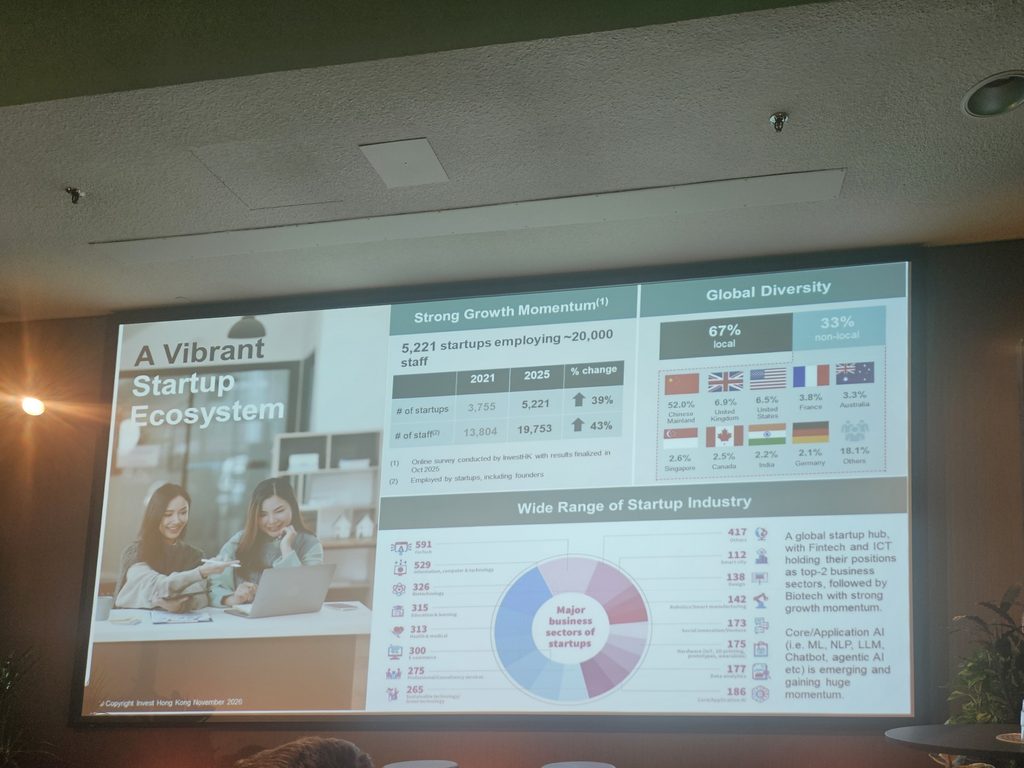
On November 18, 2026, Invest Hong Kong (InvestHK), alongside the London Economic and Trade Office, HKTDC, and HKSTP, co-hosted the first Hong Kong-focused side event at Slush 2026 in Helsinki, Finland, titled “Next Stop Asia: Scaling your I&T Business through Hong Kong.” The seminar showcased Hong Kong’s innovation and technology ecosystem under its First Five-Year Plan as a strategic gateway for Nordic and European startups expanding into Asia. Speakers highlighted major infrastructure developments—including three I&T parks, five research institutions, the Northern Metropolis, and the Hetao Shenzhen-Hong Kong Science and Technology Innovation Co-operation Zone—while featuring four portfolio companies from the HKSTP Europe Booster Programme: TG0, Janaenergy, LeafIoT Technology Limited, and Leadus Technology.



What happens when a financial centre starts behaving like an industrial venture investor? Hong Kong is giving international founders an answer: a government-backed HK$10 billion Innovation and Technology Industry-Oriented Fund (ITIF), a plan to mobilise at least HK$40 billion of public and private capital, and a vast technology-development corridor running toward Shenzhen. The promise is not simply cheaper office space. It is an attempt to connect research, institutional finance and real-world manufacturing in one ecosystem.
The timing has become especially relevant. On 12 November 2026, Hong Kong’s Legislative Council passed the Northern Metropolis Development Bill, designed to accelerate planning, land and infrastructure procedures for the city’s next growth region. It is a legislative milestone rather than a signal that every streamlined rule is already operational: detailed subsidiary legislation is expected to follow. RTHK’s contemporaneous report explains the passage and implementation timetable.
For European and Nordic deep-tech companies, this creates an intriguing strategic question: could a Hong Kong R&D or advanced-manufacturing presence attract investment and ease access to the Greater Bay Area? The answer depends on fund eligibility, demonstrable operations, intellectual-property and tax planning. It also requires separating announced budgets from money actually invested or granted.
Patient Capital: How Hong Kong Plans to Turn HK$10 Billion Into HK$40 Billion
The ITIF is designed as a fund-of-funds, not an open grant scheme sending HK$10 billion directly to startup bank accounts. Under the official programme terms, professional managers establish Hong Kong limited partnership sub-funds, with each targeting at least HK$2 billion in size. The Government is a limited partner, capped at HK$1 billion and 25% of any individual sub-fund, with an overall contribution ceiling of HK$10 billion. The intended combined size is at least HK$40 billion, implying at least HK$30 billion from non-government investors if that target is reached.
The five permitted investment themes span life and health technology; AI and robotics; semiconductors and smart devices; digitalisation and industrial transformation; and future or sustainable development. A government statement on 4 November described approximately 20 preliminarily shortlisted fund managers raising capital for the sub-funds. This is important: a shortlist and fundraising plan are not evidence that all target capital has closed or that startups can already apply to every fund. The ITIF is expected to start operating in 2026, but individual transactions depend on fund formation and investment decisions.
Hong Kong wants the capital anchored in economic activity rather than passive offshore holdings. Each sub-fund must direct at least 50% of its capital to Hong Kong companies or overseas companies establishing substantive Hong Kong operations, such as regional headquarters, R&D centres and advanced manufacturing bases. At least 25% of the sub-fund’s size must be allocated by investee companies toward establishing or operating production and manufacturing bases in Hong Kong, including pilot lines and testing. A mailbox company with no operational substance is not the investment model the scheme describes.
Create a Low TAX Cyprus Company with One Click!
Register a company in Cyprus and benefit from low taxes and great business benefits.

Northern Metropolis and New Law Changes the Development Timetable
The capital strategy needs a physical home. Hong Kong’s Northern Metropolis covers approximately 30,000 hectares, or close to one-third of the territory’s land area. Government plans envision space for around 2.5 million residents and approximately 650,000 jobs when fully developed. Those figures are long-term planning ambitions, not today’s population or employment count. From a business perspective the geography is significant: the district sits beside Shenzhen, enabling closer connections to suppliers, research institutes and manufacturers.
On 12 November lawmakers passed a dedicated Northern Metropolis Development Bill, designed to facilitate procedures concerning town planning, land resumption and works, and to enable mechanisms for cross-boundary flows of people, materials and data. The administration indicated that subsidiary measures could be submitted in January 2027, with an aim to bring facilitating provisions into operation in the first quarter of that year. The Government’s original bill explanation identifies the intended scope. Companies should treat streamlined approvals as an implementation project, not as a current blanket exemption from planning, privacy, labour or cross-border compliance requirements.
The district is expected to combine innovation, higher education, logistics, professional services, urban development and environmental areas. Its development is an exercise in long-term land supply as well as industrial policy. For prospective entrants, the commercial opportunity lies in whether laboratories, talent, transport links and pilot-manufacturing facilities arrive on a timetable compatible with the company’s product roadmap. A promising government masterplan does not by itself solve utility connections, permitting or site-selection risk.
RELOC8 AI Agents
Talk to our AI Agents and find your ideal tax destination in complete privacy!

Hetao and San Tin Are Two HK$10 Billion Anchors on the Shenzhen Frontier
Hong Kong’s 2026–27 Budget separately identified HK$10 billion to accelerate development of the Hetao Hong Kong Park and a proposed HK$10 billion initial capital injection for a company developing San Tin Technopole. These are infrastructure and development commitments, not additional venture grants to be added to the ITIF’s projected HK$40 billion investment pool. The official Budget overview also identifies a separate HK$10 billion initiative for Hung Shui Kiu Industry Park, underscoring why headlines about a single HK$50 billion package can blur several distinct programmes.
The Hetao project, also known as the Loop Hong Kong Park, physically links the Hong Kong and Shenzhen sides of an innovation cooperation zone. Its Hong Kong section officially opened at the end of 2025; its first wet-laboratory buildings and talent accommodation were reported commissioned, while the Loop Academy One building had topped out by September 2026. The park’s FY2025/26 annual report describes that progress. The zone is intended to facilitate cross-boundary R&D, including life sciences, advanced manufacturing, AI and research collaboration, while operational rules for particular movements still require careful checking.
San Tin Technopole is positioned as the next industrial expansion area for the Northern Metropolis. Its proposed development company and initial capital would support land formation, infrastructure and the capacity for scaling firms beyond a lab prototype. Together, Hetao and San Tin could provide a progression from university research and proof of concept to testing, manufacturing and access to the broader regional supply chain. The actual availability of space, incentives and permits will depend on staged implementation and the applicable development approvals.
RELOC8 WORLD TAX INDEX!
See all countries and global TAXES in detail.

More Than One Fund: RAISe+, Industrialisation and Startup R&D Support
The ITIF is not Hong Kong’s only innovation-finance tool. The HK$10 billion Research, Academic and Industry Sectors One-plus Scheme (RAISe+) has supported commercialisation of research outcomes since 2023. Separately, the HK$10 billion New Industrialisation Acceleration Scheme launched in 2024 to support strategically important smart production facilities. These programmes address different stages and applicants: university-linked research, private industrial investment and institutional fund financing should not be treated as interchangeable sources of immediate startup cash.
Smaller firms may have a more direct funding route. Hong Kong’s Enterprise Support Scheme provides dollar-for-dollar matching support of up to HK$10 million per approved private-sector R&D project, subject to eligibility and assessment. A company would normally need to demonstrate qualifying R&D activity, resources for its own contribution and a credible commercialisation plan. Being an overseas founder, or merely registering a Hong Kong entity, does not itself secure approval.
Existing ecosystem institutions broaden the route to market: Hong Kong Science Park and its research infrastructure, Cyberport for digital companies, university transfer offices and specialist applied-research organisations. For a business developing medical devices, chip components, manufacturing software or industrial AI, the real strategic question is how to sequence research partnerships, private funding and production infrastructure — and how to preserve the rights to the resulting intellectual property.
RELOC8 DESTINATION SELECTOR!
Answers a few questions and find your ideal tax destination in under 3 minutes!

The Tax Angle: What International Founders Should Check Before Expanding
Hong Kong’s existing corporate tax system is relevant but separate from these funding commitments. Under the current Inland Revenue Department profits-tax guidance, qualifying corporations can generally face 8.25% on their first HK$2 million of assessable profits and 16.5% above that level, subject to the two-tier regime’s restrictions. Its enhanced R&D deduction rules can allow 300% deductions on the first HK$2 million of qualifying Type B R&D expenditure and 200% thereafter. These deductions reduce taxable profits; they are not a cash grant of three times the expenditure.
A further incentive is being discussed, but investors should avoid treating it as enacted legislation. The 2026 Policy Address announced plans for proposed preferential profits-tax rates of 5% or half-rate for selected enterprises in strategic industries, subject to future statutory amendments, sector criteria and economic-contribution tests. The Government intended to present legislation by the end of 2026. As of this article’s publication, companies should model such concessions as a potential scenario, not a guaranteed effective tax rate.
Consider a hypothetical European robotics business preparing a Hong Kong pilot line. Its decision checklist should include: fund-manager mandate and eligibility; substantive R&D and employment plans; where patents, software and know-how are developed and owned; contracts with mainland suppliers; customs and cross-border data obligations; local and foreign corporate tax residence, transfer pricing and withholding; and immigration permissions for staff. An attractive co-investment ratio does not eliminate these questions. For internationally mobile founders, RELOC8 ONLINE’s starting principle remains Right Place, Right Tax, Right Now.
Sail The Bright Future
Take the stress out of relocating. Our experts are here to guide you every step of the way. Start your journey toward tax efficiency today.

General Disclaimer: The information provided in this article is for informational purposes only and was obtained from verifiable sources at the time and date of publication. It is not in any shape or form financial or investment advise and should not under any circumstances be treated as such. This information does not constitute legal advice and should not be relied upon as such. RELOC8 ONLINE is not responsible for any errors, inaccuracies, or inconsistencies that might be present in the content published here and readers are advised to carry out their own research on the topics discussed before making decisions that might impact their circumstances. For the latest information and most accurate details, please refer to our Latest News page or contact us directly.
AI Disclaimer: We use artificial intelligence (AI) and generative AI to help produce our content; while all outputs undergoes a level of human verification, errors or inaccuracies may still occur. We assume no editorial or legal responsibility for the outputs. This content is not intended to inform the public on matters of public interest (such as politics, public health, consumer safety, or environmental claims). If you believe any published content violates these guidelines or contains inaccuracies, please notify us via our contact us page so we can address it promptly.