
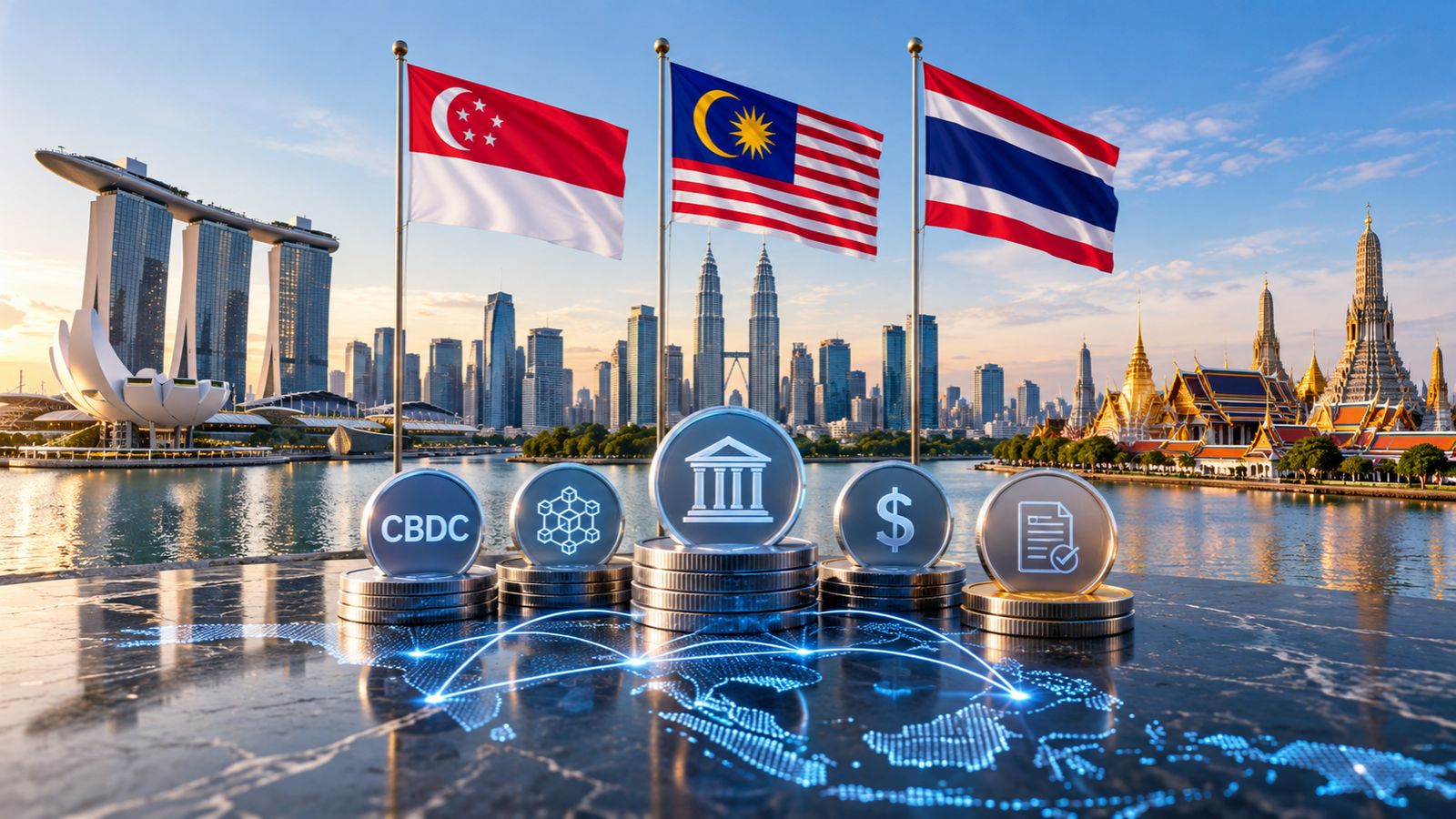
Singapore, Malaysia and Thailand have joined forces through the BLOOM initiative to develop common frameworks for cross-border settlement using tokenised bank deposits and regulated stablecoins. For HNWIs and family offices, the development points towards a future in which digital assets are not simply investments — they become part of the infrastructure used to move conventional wealth across borders.
Three Asian Central Banks Are Building a Digital-Money Settlement Framework
On 23 October 2026, the Monetary Authority of Singapore announced that Bank Negara Malaysia and the Bank of Thailand had joined BLOOM — Borderless, Liquid, Open, Online, Multi-currency — as policymaker members. The initiative is designed to develop practical frameworks for how different forms of digital money can be accepted, exchanged and settled across institutions and jurisdictions.
The project specifically includes tokenised commercial bank deposits and regulated stablecoins, with work focused on cross-border settlement, interoperability between different systems and programmable compliance controls such as identity verification, sanctions screening and transaction restrictions.
This is significant because the initiative brings central banks directly into the question of how privately issued digital money can operate across regulated financial systems rather than remaining confined to isolated blockchain networks.
Create a Low TAX Cyprus Company with One Click!
Register a company in Cyprus and benefit from low taxes and great business benefits.

Major Banks, Payments Companies and Crypto Firms Are Already Involved
BLOOM’s participant list now includes a striking combination of conventional finance and digital-asset companies. Participants include DBS, OCBC, UOB, Standard Chartered, J.P. Morgan, Mastercard, Visa and Temasek alongside Circle, Coinbase, Ripple, StraitsX and other fintech and infrastructure providers. The World Bank Group has also joined the initiative.
That mixture is important because tokenised finance cannot scale if banks, blockchain firms, payment networks and regulators each develop systems that cannot communicate with one another. BLOOM is explicitly attempting to create common approaches to acceptance and settlement so institutions do not need to build a separate bilateral arrangement for every counterparty and market.
For family offices, that means the most important digital-finance developments may increasingly occur inside major regulated institutions rather than on retail cryptocurrency exchanges.
RELOC8 AI Agents
Talk to our AI Agents and find your ideal tax destination in complete privacy!

Stablecoins Are Moving From Trading Tools to Settlement Assets
Stablecoins are often associated with crypto trading, but regulators increasingly see well-regulated forms of stable value digital money as potential settlement instruments for tokenised financial markets. Singapore has already been developing a dedicated regulatory framework covering single-currency stablecoins and is examining how foreign-issued and multi-jurisdictional stablecoins could fit into regulated cross-border activity.
MAS has repeatedly emphasised that tokenised deposits, stablecoins and wholesale central-bank digital currency may serve different functions rather than one form replacing all others. Tokenised bank deposits could play a strong role in institutional cash management, while properly regulated stablecoins may be useful in payments and blockchain-based markets.
That is a much more mature debate than asking whether cryptocurrency will replace banks. The emerging model is one in which banks themselves operate tokenised money alongside regulated blockchain-based settlement assets.
RELOC8 WORLD TAX INDEX!
See all countries and global TAXES in detail.

Malaysia Is Tokenising Bonds at the Same Time
The regional move is already extending beyond payments. On 20 October, Bank Negara Malaysia launched SSDS+, a new platform for issuing and safeguarding tokenised bonds and sukuk. The platform uses distributed-ledger technology and connects tokenised securities with payment settlement in central-bank money.
Bank Negara says the infrastructure can support wholesale issuances while also being capable of supporting tokenised government and corporate retail bonds. Combined with Malaysia’s involvement in BLOOM, this suggests that tokenised securities and digital settlement money are developing together rather than as separate experiments.
For investors, the distinction matters because ownership can move onto blockchain infrastructure even when the underlying investment remains familiar: a bond, fund, bank deposit or other conventional financial claim.
Cross-Border Wealth Could Become Faster — but Not Tax-Free
The appeal for internationally mobile investors is obvious. Traditional cross-border transactions can involve multiple banks, currency conversions, cut-off times, correspondent accounts and separate compliance processes. Tokenised settlement infrastructure could eventually reduce some of that friction and enable more rapid movement between regulated institutions and markets.
But faster settlement does not remove tax residence, beneficial ownership or reporting requirements. If an individual resident in one jurisdiction owns a tokenised bond issued in another jurisdiction through a family company elsewhere, the underlying tax and legal questions remain. Blockchain changes how the asset is recorded and transferred; it does not make the owner jurisdictionless.
Indeed, programmable compliance could make the opposite true. Digital-money systems can potentially embed identity verification, sanctions screening and transaction controls directly into the settlement process.
RELOC8 DESTINATION SELECTOR!
Answers a few questions and find your ideal tax destination in under 3 minutes!

Asia Is Building Infrastructure for the Next Generation of Private Wealth
Singapore has spent years positioning itself as a hub for private wealth, family offices, asset management and regulated digital finance. BLOOM now extends that strategy from asset tokenisation towards the money used to settle those assets, while bringing Malaysia and Thailand into a wider regional architecture.
For HNWIs, this is important because the divide between “crypto wealth” and “traditional wealth” is becoming less useful. A family office may soon hold ordinary investment exposures — bonds, funds, deposits or private credit — on tokenised infrastructure without viewing itself as a cryptocurrency investor at all.
The strategic question increasingly becomes where those assets are issued, custodied, reported and taxed rather than whether they are technically recorded on a blockchain.
RELOC8 ONLINE examines digital wealth within the broader framework of tax residence, family-office structuring, international mobility and cross-border asset ownership.
Right Place, Right Tax, Right Now.
Sail The Bright Future
Take the stress out of relocating. Our experts are here to guide you every step of the way. Start your journey toward tax efficiency today.

General Disclaimer: The information provided in this article is for informational purposes only and was obtained from verifiable sources at the time and date of publication. It is not in any shape or form financial or investment advise and should not under any circumstances be treated as such. This information does not constitute legal advice and should not be relied upon as such. RELOC8 ONLINE is not responsible for any errors, inaccuracies, or inconsistencies that might be present in the content published here and readers are advised to carry out their own research on the topics discussed before making decisions that might impact their circumstances. For the latest information and most accurate details, please refer to our Latest News page or contact us directly.
AI Disclaimer: We use artificial intelligence (AI) and generative AI to help produce our content; while all outputs undergoes a level of human verification, errors or inaccuracies may still occur. We assume no editorial or legal responsibility for the outputs. This content is not intended to inform the public on matters of public interest (such as politics, public health, consumer safety, or environmental claims). If you believe any published content violates these guidelines or contains inaccuracies, please notify us via our contact us page so we can address it promptly.