
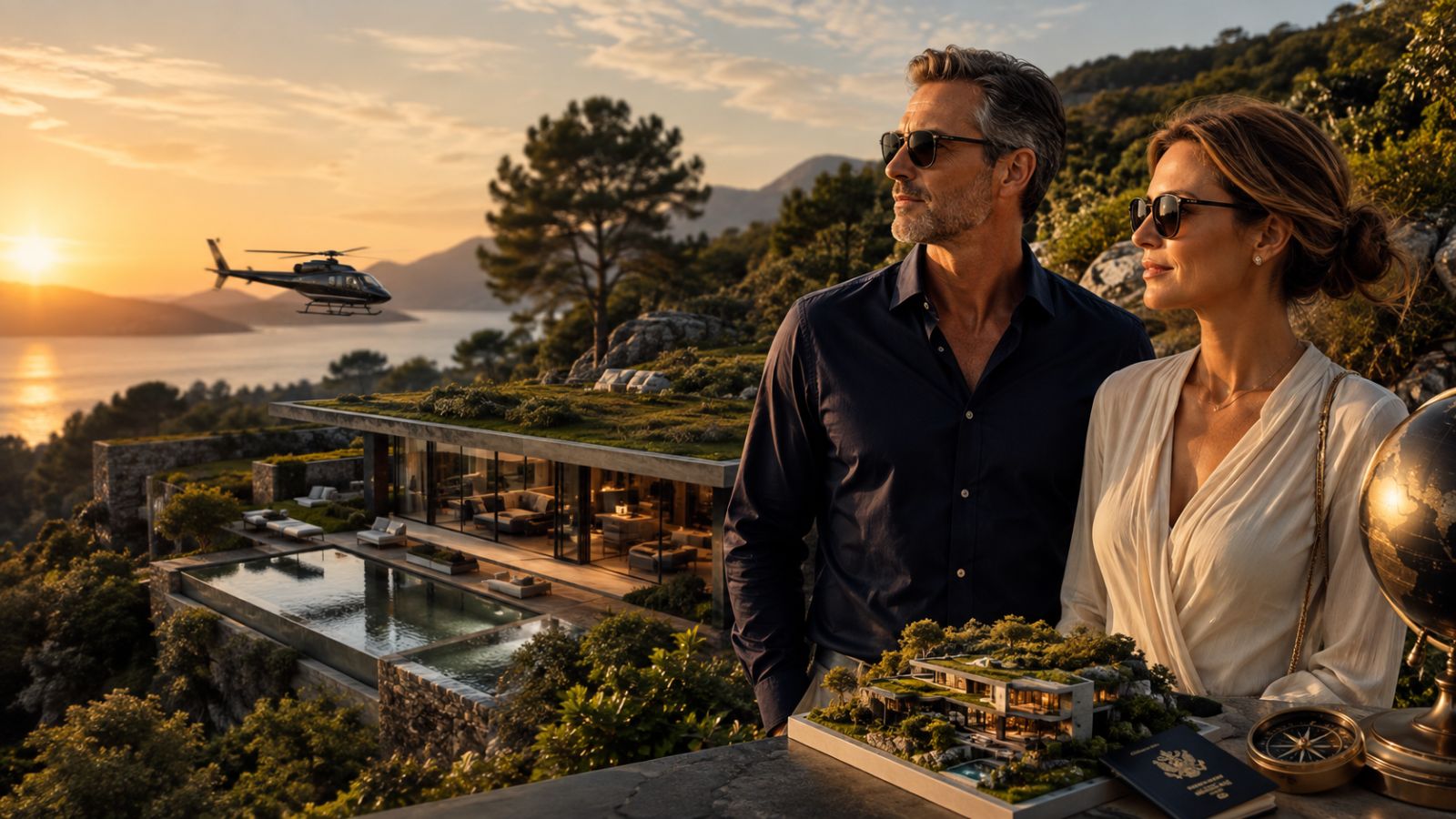
Billionaire Homes Are Starting to Disappear as Privacy, Security and Self-Sufficiency Redefine Global Luxury Property
The traditional trophy mansion was impossible to miss. It sat on the highest point of the landscape. It had monumental gates, an enormous driveway and architecture deliberately designed to announce the owner’s arrival. That definition of wealth is beginning to change.
Some of the world’s most ambitious ultra-luxury real estate is now being designed to almost disappear.
A recent Forbes Global Properties report highlights a new architectural movement in which multimillion-dollar residences blend into forests, mountains, deserts and coastlines rather than dominate them. Green roofs merge into hillsides. Reflective walls mirror surrounding trees. Native vegetation dictates building footprints. Local stone makes enormous residences appear almost carved out of the land itself.
For ultra-high-net-worth individuals, this goes much further than architecture.It reflects a broader transformation in the meaning of luxury. Privacy is becoming a trophy asset.
And in an era of increasing global mobility, digital exposure, geopolitical uncertainty and security concerns, the ability to own a beautiful property that attracts very little attention may ultimately be more valuable than owning one everybody can see.
Create a Low TAX Cyprus Company with One Click!
Register a company in Cyprus and benefit from low taxes and great business benefits.
Ultra-Luxury Real Estate Is Entering Its Quiet Luxury Era
Forbes described how trophy homes once communicated wealth through sheer visibility and scale. Today, some of the most sophisticated residences are speaking a much quieter architectural language.
Instead of clearing the landscape to accommodate a mansion, architects are increasingly allowing forests, rock formations, topography and climate to determine how the property is constructed.
The result can be extraordinary. Buildings stretch around mature trees. Roofs become extensions of hillsides. Reflective façades visually dissolve into woodland. Local stone allows enormous residences to become almost indistinguishable from the mountains surrounding them. The objective is no longer simply to own the landscape. It is to become part of it.
For wealthy buyers, that can provide something increasingly difficult to purchase in a hyperconnected world: discretion.
This shift also fits a broader luxury trend identified during 2026. Sotheby’s International Realty has highlighted increasing demand for privacy in the luxury residential market, while Coldwell Banker Global Luxury reported that sales of detached luxury homes increased 4.2% in 2025 as privacy, space and long-term adaptability became more important to affluent buyers.
Luxury real estate is therefore becoming less about how loudly a property communicates wealth from the outside. It is increasingly about how much freedom the property creates for the people living inside it.
RELOC8 AI Agents
Talk to our AI Agents and find your ideal tax destination in complete privacy!

The Aspen House Where Nature Literally Walks Across the Roof
One of the clearest examples highlighted by Forbes sits in Aspen, Colorado.
GLUCK+’s House in the Mountains does not simply overlook its natural environment. The residence effectively continues it.
The 2,850-square-foot guest house incorporates the landscape into its roofline so successfully that moose reportedly walk across it during spring.
That architectural concealment is paired with another feature increasingly relevant to UHNW buyers: self-sufficiency.
A south-facing solar wall generates enough energy to power the all-electric property, according to Forbes, including heating its swimming pool and hot tub through Colorado’s winters. That combination is important.
The modern trophy property is beginning to combine:
privacy, energy independence, land, nature, resilience, and architectural quality.
For a globally mobile owner, those characteristics can offer something that another marble staircase or larger entertainment room cannot.
They provide greater control over the environment in which the owner lives.
RELOC8 WORLD TAX INDEX!
See all countries and global TAXES in detail.

In Sicily, Ancient Architecture Becomes Modern Luxury
The same trend is appearing thousands of kilometres away.
Outside Noto in Sicily, the Villa Antique development uses architecture rooted in the island’s history rather than importing an international glass-box aesthetic.
The 12-villa development sits among centuries-old olive groves close to archaeological sites around Ancient Noto and Castelluccio. Thick limestone walls, courtyards and locally sympathetic materials draw on techniques that existed long before modern mechanical cooling.
The significance for luxury property buyers is not simply aesthetic. Scarcity matters. Authenticity matters. And increasingly, place matters. A residence which could be recreated almost anywhere may be luxurious, but it is not necessarily rare.
A property intrinsically connected to a particular landscape, climate and history is much harder to reproduce.
That scarcity can form a different category of trophy ownership — one based less on conspicuous scale and more on access to something almost impossible to replicate elsewhere.
RELOC8 DESTINATION SELECTOR!
Answers a few questions and find your ideal tax destination in under 3 minutes!

Big Sur Shows Why the Landscape Is Becoming Part of the Asset
On California’s dramatic Big Sur coastline, another residence featured by Forbes uses stone walls that echo the surrounding rock formations.
Existing native cypress trees were preserved, while natural ravines helped determine the building’s footprint. Large expanses of glass frame the Pacific rather than visually competing with it.
This demonstrates another major change in ultra-luxury real estate.
Land is no longer merely the space surrounding the house.
The landscape itself is becoming part of the luxury asset.
Coldwell Banker recently described a related American trend as “landmaxxing” — wealthy buyers prioritising larger amounts of land, privacy and scarcity and increasingly viewing physical property as a way to anchor wealth during periods of economic and geopolitical uncertainty.
For UHNW families, acreage creates possibilities that an urban penthouse simply cannot.
Distance from public roads. Controlled access. Outdoor recreation. Additional guest residences. Greater physical separation from neighbours. Potential energy infrastructure. And, depending on the property and local regulation, greater capacity to create a genuinely private family compound. The mansion is no longer the entire trophy. The land around it may be equally important.
Villa Oak in Spain Takes Architectural Invisibility Even Further
Perhaps the most striking example is Villa Oak in Sotogrande, Spain.
Forty-two cork oak trees already occupied the property before the residence was designed.
Instead of removing them, Fran Silvestre Arquitectos digitally scanned the trunks and root systems before developing the building around the existing forest.
Long horizontal forms pass between the trees, while reflective aluminium surfaces mirror their surroundings, creating what Forbes describes as a sense of disappearance.
Yet the property does more than disappear visually.
Its proposed systems include geothermal technology, solar panels and battery storage, with the design targeting net-zero energy consumption.
That combination may tell us far more about the future of billionaire property than another record-breaking square-footage figure.
A new formula for trophy real estate is emerging:
Discretion + Land + Technology + Energy Resilience + Exceptional Architecture.
The result does not necessarily look wealthier from the road.
That may be precisely the attraction.
Privacy Is Becoming a Global Luxury Status Symbol
This movement is not confined to property.
Across different corners of the luxury economy, privacy is increasingly being treated as something affluent consumers are prepared to pay significant premiums to obtain.
Recent Financial Times reporting has examined privacy itself as an emerging luxury, particularly among wealthy individuals capable of limiting their public and digital exposure.
Business Insider has observed a similar phenomenon in UHNW travel, where wealthy clients increasingly favour private villas, secluded homes, private aviation and tightly controlled itineraries rather than simply choosing the most prestigious conventional hotel.
And reporting on the newest generation of technology wealth suggests younger ultra-rich consumers are placing greater emphasis on privacy, personalisation and efficiency across jets, yachts, automobiles and property.
Real estate fits naturally into this transformation.
If privacy becomes valuable in the air, online and while travelling, the primary residence or second home becomes the ultimate private environment.
For that reason, an “invisible mansion” should not simply be viewed as an architectural curiosity.
It may represent the physical expression of a much larger shift in how modern wealth defines freedom.
Security Is Also Changing the Meaning of a Trophy Home
There is an important distinction.
A house that visually disappears into a forest is not automatically a secure property.
Architectural discretion and physical security are different things.
However, the demand for the two increasingly overlaps.
Sotheby’s 2026 luxury-market commentary identifies safety and privacy as priorities influencing residential design, including greater attention to advanced security and backup systems.
Other reporting this year has described wealthy homeowners investing heavily in sophisticated residential security as concerns grow around physical threats and the amount of personal information available online.
For globally visible entrepreneurs, investors, public-company executives and family-office principals, the value proposition becomes clear.
The ideal residence increasingly needs to manage two contradictory objectives:
provide an exceptional lifestyle,
while revealing as little as possible to the outside world.
That can influence everything from the location and driveway to landscaping, sightlines, vehicle access, staff circulation and surrounding land.
The most impressive security feature may ultimately be a home that does not appear impressive at all from outside its boundaries.
Self-Sufficiency Is Becoming Part of the Luxury Equation
The Forbes examples also reveal something else.
Several of these properties are not simply private.
They are increasingly resilient.
Villa Oak uses solar generation, battery storage and geothermal systems. The Aspen property was designed around all-electric energy generation. Sicilian architecture employs passive principles developed for the local climate long before modern air conditioning existed.
This matters because the priorities of wealthy homeowners are expanding.
Luxury once meant adding more. More rooms. More marble. More staff. More visible amenities. The emerging version of luxury can mean requiring less from the outside world. Less exposure. Less reliance on external infrastructure. Less unwanted visibility. More control. That is closely connected to the philosophy of the Freedom Economy.
A strategically selected residence can be more than somewhere to live. For internationally mobile families, it can form part of a broader framework incorporating residency, lifestyle, mobility, asset diversification and long-term family planning.
Property therefore needs to be considered alongside the jurisdiction in which it sits.
Why Global Mobility Changes the Luxury Property Decision
For a globally mobile HNWI, choosing an extraordinary house without evaluating the country surrounding it can be a major strategic mistake.
A spectacular residence is only one component of international relocation.
Buyers also need to consider issues such as:
personal and corporate tax exposure; tax residency rules; immigration and residency rights; property ownership restrictions; succession and inheritance rules; security and political stability; international schools and healthcare; airport and private aviation access; banking and financial infrastructure; climate and environmental risks; connectivity to other global business centres.
The world’s wealthiest individuals increasingly have the ability to choose not only what they own but where they live.
Knight Frank’s 2026 Wealth Report describes private capital as adapting to a fractured geopolitical environment by seeking greater agility, while its research continues to track the movement of wealth between competing global hubs.
Prime residential property remains part of that equation. Knight Frank’s PIRI 100 found that global luxury residential prices increased by an average of 3.2% during 2025, although performance varied considerably between regions.
For mobile wealth, therefore, buying the right house and choosing the right jurisdiction increasingly become part of the same decision.
The Ultimate Trophy May Be the Freedom to Disappear
The billionaires’ mansion is not disappearing. Its definition is changing. There will always be buyers who want enormous waterfront estates, record-breaking penthouses and homes designed to attract attention. But another form of status is developing alongside them. It values an estate hidden behind acres of land rather than one visible from the road. It values energy independence alongside a wine cellar. It values architecture that preserves mature trees rather than removing them. It values silence. Privacy. Control. And the freedom to decide when — and whether — the outside world gets access. Forbes’ examples from Aspen, Sicily, Big Sur, Sotogrande, Mexico and Santa Fe demonstrate how architects are translating those priorities into physical form. For ultra-high-net-worth buyers, the trend also carries a larger message. The ultimate display of wealth may increasingly be having nothing left to prove. The old trophy mansion demanded to be noticed. The new one can afford to disappear.
Build Your Global Property Strategy Around the Right Jurisdiction
International real estate decisions should not be separated from tax residency, mobility and long-term wealth planning.
RELOC8 ONLINE helps internationally mobile entrepreneurs, investors and families evaluate jurisdictions as part of a broader tax migration and relocation strategy, including international tax planning, business relocation, company structuring and related cross-border considerations.
If your next property acquisition could also become your second home, international base or future residence, consider the entire jurisdiction — not simply the view from the terrace.
Right Place, Right Tax, Right Now.
Sail The Bright Future
Take the stress out of relocating. Our experts are here to guide you every step of the way. Start your journey toward tax efficiency today.

General Disclaimer: The information provided in this article is for informational purposes only and was obtained from verifiable sources at the time and date of publication. It is not in any shape or form financial or investment advise and should not under any circumstances be treated as such. This information does not constitute legal advice and should not be relied upon as such. RELOC8 ONLINE is not responsible for any errors, inaccuracies, or inconsistencies that might be present in the content published here and readers are advised to carry out their own research on the topics discussed before making decisions that might impact their circumstances. For the latest information and most accurate details, please refer to our Latest News page or contact us directly.
AI Disclaimer: We use artificial intelligence (AI) and generative AI to help produce our content; while all outputs undergoes a level of human verification, errors or inaccuracies may still occur. We assume no editorial or legal responsibility for the outputs. This content is not intended to inform the public on matters of public interest (such as politics, public health, consumer safety, or environmental claims). If you believe any published content violates these guidelines or contains inaccuracies, please notify us via our contact us page so we can address it promptly.