
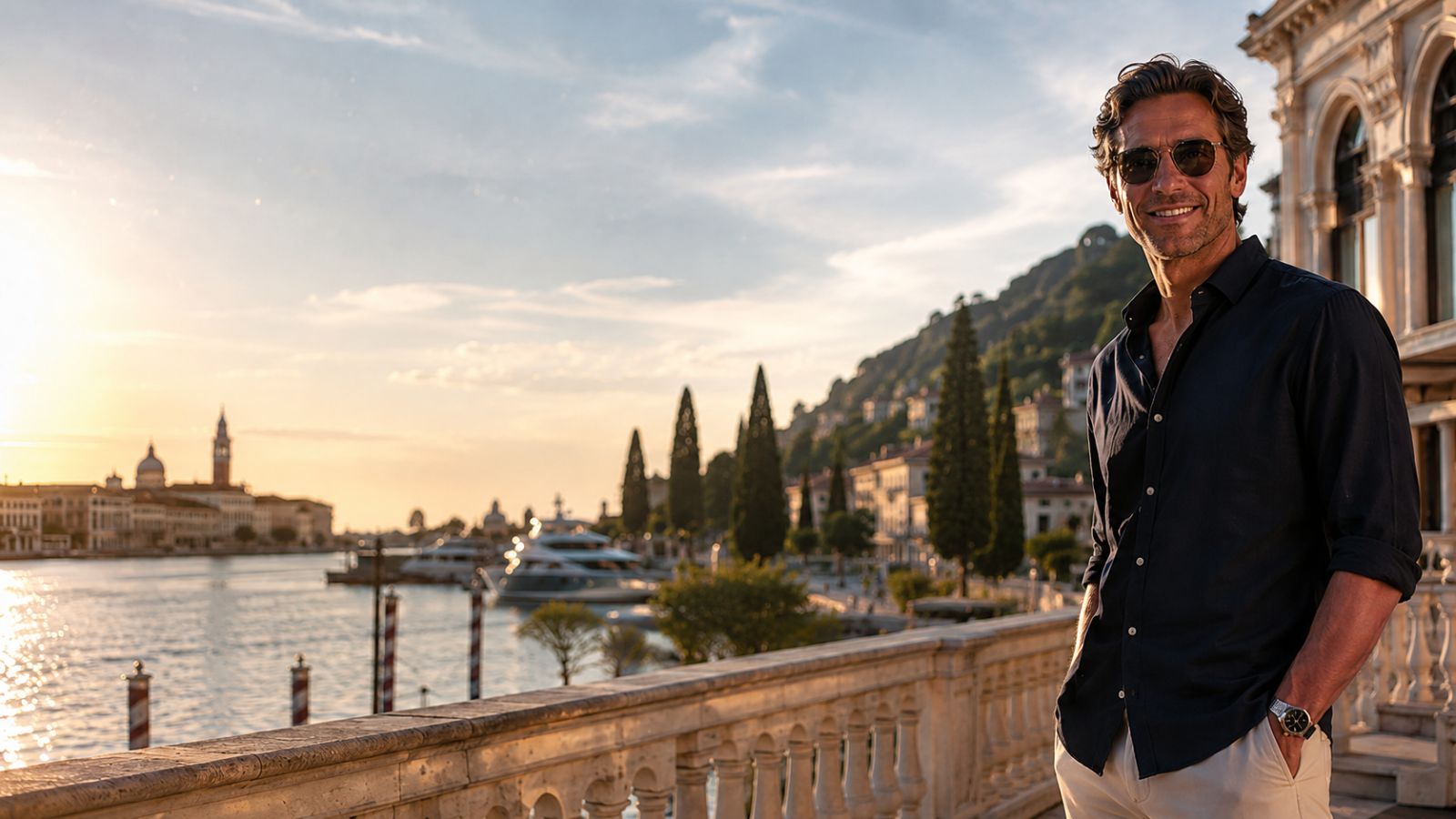
Why One of the World’s Most Successful Hedge Fund Managers Is Quietly Building Exposure to Venice, Capri, Lake Como and Milan
Italy’s most exclusive hotels are becoming something more than places where the world’s wealthy spend their summers. They are increasingly being treated as institutional investment assets, and billionaire investor Sir Christopher Hohn’s hedge fund, The Children’s Investment Fund Management, has built $636 million of exposure to loans linked to ultra-luxury Italian hotels, according to reporting published by the Financial Times on 18 August 2026.
The portfolio reads almost like a map of where global wealth travels in Italy, spanning Venice, Capri, Lake Como and Milan. TCI’s largest position is connected to the legendary Hotel Danieli in Venice, while other exposures are tied to Hotel Caesar Augustus in Capri, a Six Senses development on Lake Como and Mandarin Oriental in Milan. All four properties are owned by Italian real estate group Gruppo Statuto.
The significance, however, extends well beyond one hedge fund buying hotel debt. Hohn has built his investment career around businesses with strong pricing power, and his move into Italian luxury hospitality suggests that some of the world’s most sophisticated capital sees long-term value in scarce, exceptional experiences located in places that cannot easily be replicated. For high-net-worth investors, family offices and internationally mobile entrepreneurs, that thesis deserves attention because Italy’s luxury hotel boom is revealing something larger about how global wealth is moving, travelling and allocating capital.
Create a Low TAX Cyprus Company with One Click!
Register a company in Cyprus and benefit from low taxes and great business benefits.

The $636 Million Portfolio Behind the Bet
TCI is primarily known for major listed-equity investments rather than hotels. Its roughly $77 billion master fund has held significant positions in companies including Alphabet, GE Aerospace and French infrastructure group Vinci, yet a comparatively discreet part of the portfolio has also been allocated to real estate debt, with much of that exposure concentrated in Italian luxury hospitality.
The Italian hotel positions reported by the Financial Times comprise approximately $392 million linked to Hotel Danieli in Venice, $132 million to Hotel Caesar Augustus in Capri, $74 million to Six Senses on Lake Como and $38 million to Mandarin Oriental in Milan, taking the total to $636 million.
This is an unusually concentrated collection of trophy destinations. Venice is one of the world’s most supply-constrained historic cities, Capri is synonymous with Mediterranean luxury, Lake Como has evolved into one of Europe’s most recognisable UHNW lifestyle destinations, and Milan combines fashion, finance, luxury retail and international business. TCI is therefore not simply taking exposure to “Italian hotels”; it is gaining exposure to locations where scarcity, global wealth and international demand intersect.
This Is Not a Conventional Hotel Acquisition
There is an important distinction for investors. TCI has not simply purchased $636 million worth of hotel buildings. The fund has acquired interests in loans connected to these properties, giving it exposure through private real estate credit rather than through straightforward hotel ownership. The loans were originated through a private-credit business in which TCI itself has an interest.
That changes the investment profile. Hotel ownership exposes an investor directly to property values, operating performance, capital expenditure and eventual disposal prices, whereas real estate debt positions capital within the financing structure. For large institutional investors and family offices, private credit can provide another way to participate in real estate without taking the same level of equity risk as an outright owner.
The more revealing point is the quality of the collateral behind the loans. These are not interchangeable motorway hotels or mass-market properties; they are scarce luxury assets in globally recognised locations. That appears closely aligned with Hohn’s broader investment philosophy: favour assets capable of defending their economics because competitors cannot easily recreate what they own.
RELOC8 AI Agents
Talk to our AI Agents and find your ideal tax destination in complete privacy!

Venice Shows Why Scarcity Matters
Hotel Danieli is perhaps the clearest example of that idea. The historic Venetian property sits beside the lagoon near Piazza San Marco and occupies three historic palaces. Four Seasons officially reopened Danieli on 30 July 2026 following a major restoration, initially returning 120 rooms and suites to the market. Once restoration work on Palazzo Danieli Excelsior is completed in 2027, total accommodation is expected to rise to 168 rooms and suites.
TCI’s exposure to a loan associated with Danieli is approximately $392 million, making it by far the largest individual position in the reported Italian portfolio.
The investment case becomes clearer when considering how difficult such an asset would be to reproduce. A competing operator would need a comparable location, centuries of history, architectural distinction, lagoon views, brand prestige and the ability to navigate restrictive planning and heritage rules. That is the fundamental advantage of trophy hospitality: a standard hotel room can be replicated, but a Venetian palace overlooking the lagoon cannot. Scarcity therefore becomes part of the business model.
Italy’s Luxury Hotels Have Developed Serious Pricing Power
TCI’s bet is particularly interesting because luxury hospitality has been dramatically outperforming much of the conventional hotel sector. According to figures cited by the Financial Times from Cushman & Wakefield, Italian hotel revenue per available room increased 53% between 2019 and the end of 2025, outperforming every other European country over that period, with the strongest growth coming from the luxury segment.
Europe’s ultra-luxury segment has shown similar strength more broadly. Savills reported in its 2026 European hotel outlook that RevPAR across selected European ultra-luxury markets was 57% above 2019 levels, compared with 47% for luxury hotels and 24% for non-luxury properties. Italy and France were among the destinations displaying particularly strong luxury performance.
The implications are important. The wealthy are not simply travelling more; they are demonstrating a willingness to pay materially higher prices for specific experiences. At the highest end of hospitality, price increases have not necessarily destroyed demand, and in some cases the perception of exclusivity may even reinforce it.
RELOC8 WORLD TAX INDEX!
See all countries and global TAXES in detail.

Wealthy Travellers Are Behaving Differently From the Mass Market
The modern luxury travel economy is becoming increasingly separated from conventional consumer spending. Affluent households can be far less sensitive to changes in room prices than middle-income travellers, particularly when the decision is based on privacy, service, location, security, wellness, space and access rather than price alone.
For someone paying thousands of euros per night for a suite in Venice or Capri, the relevant question is rarely whether another hotel somewhere else is cheaper. The destination itself forms part of the product. A traveller who wants Lake Como is not necessarily going to substitute it with a less expensive lake elsewhere, just as someone seeking Venice or Capri may not view another historic city or Mediterranean island as equivalent. That ability to command demand around a uniquely identifiable place gives exceptional properties an economic advantage that ordinary hotels rarely possess.
The Institutional Money Is Already Arriving
TCI is not acting in an empty market. Fresh JLL figures show that hotels and hospitality represented more than 10% of total Italian real estate investment volumes during the first half of 2026. Direct hotel transactions reached approximately €860 million, while another €260 million went into conversion projects, taking hospitality-related investment to roughly €1.1 billion during H1 2026.
Tourism fundamentals have also remained powerful. Italy recorded approximately 71.6 million overnight stays during the first quarter of 2026, up 7.5% year-on-year, according to JLL, while international visitors were responsible for more than half of arrivals.
The investor outlook is equally striking. A JLL survey conducted among senior hotel investors in May 2026 found that nearly three-quarters expected to be net buyers of Italian hotel assets over the following 12 to 24 months. More than half of respondents managed hotel portfolios worth at least €500 million, while almost 40% oversaw more than €1 billion of assets.
This is no longer a niche property trend. Institutional capital is positioning around Italy.
RELOC8 DESTINATION SELECTOR!
Answers a few questions and find your ideal tax destination in under 3 minutes!

Private Wealth Is Moving Into Italian Real Estate Too
There is another layer to the story that matters particularly to RELOC8 readers. Italy is attracting not only institutional property investors but private wealth. JLL estimates that private wealth investors deployed approximately €1.7 billion into Italian real estate during the first half of 2026, representing more than 20% of total investment volumes. International capital represented roughly 75% of all Italian real estate investment during the period.
That creates an important convergence. International investors are buying Italian real estate, wealthy travellers are paying premiums to experience Italy, private capital is increasingly entering the property market, global hotel brands are expanding, and sophisticated alternative investment managers are financing trophy hospitality assets. These trends are not identical, but they are reinforcing one another.
Italy increasingly operates at the same time as a place to travel, a place to own assets, a place to deploy capital and, for some internationally mobile families, a place to establish a lifestyle base.
Lake Como Is Becoming a Global Wealth Ecosystem
Lake Como illustrates the transformation particularly well. What was once primarily seen as an elite holiday destination increasingly sits inside a much larger global luxury ecosystem, attracting celebrities, entrepreneurs, executives, family offices and wealthy second-home buyers while simultaneously drawing investment from the world’s leading hospitality brands.
Six Senses has announced its own Lake Como property in partnership with Gruppo Statuto, continuing its expansion in Italy following Six Senses Rome.
Luxury hotel development can strengthen the surrounding wealth ecosystem because premium hospitality brings with it restaurants, wellness infrastructure, concierge services, international staff, private transport, destination management and greater global visibility. For owners of nearby prime residential property, that matters too. The boundary between luxury hospitality and luxury residential real estate is becoming increasingly blurred in major wealth destinations, and top-tier hotels can become anchors around which wider luxury markets develop.
The Same Story Is Playing Out in Milan
Milan represents a different version of the investment thesis. Unlike Capri or Lake Como, it is not primarily a resort market. It combines finance, fashion, design, business travel, shopping and luxury culture, creating a broader pool of demand throughout the year.
Mandarin Oriental operates in the centre of Milan close to La Scala, the Duomo and the city’s principal luxury shopping streets.
That diversity can be particularly valuable because a trophy hotel in Milan is exposed not only to holiday travellers but also to executives, international investors, fashion-industry clients, luxury shoppers and visitors attending major events. Italy’s luxury hospitality market therefore does not depend on a single customer profile; its strongest locations serve several different forms of global wealth.
Why Hohn’s Investment Philosophy Matters
The identity of the investor makes the story more significant. Hohn is known for focusing heavily on pricing power, which ultimately means asking whether an asset can continue raising prices without destroying demand.
In many industries, competitors eventually arrive and force margins lower. Trophy hotels can be different because some of their advantages are structurally impossible to replicate. Nobody can manufacture another Venice, create another centuries-old palace on precisely the same lagoon frontage, mass-produce prime Lake Como shoreline or expand the island of Capri because demand has increased.
Planning restrictions, geographic limitations, heritage rules and the scarcity of appropriate buildings can restrict new supply in precisely the places wealthy travellers most want to visit. That creates an unusual equation in which demand can continue growing while the most desirable supply remains permanently constrained. For investors searching for durable pricing power, that is highly attractive.
Italy’s Luxury Boom Is Not Risk-Free
The bull case still has an obvious challenge: success attracts competition. Major international hotel groups are accelerating their expansion across Italy, bringing additional ultra-luxury supply into cities and resort destinations that have enjoyed exceptional post-pandemic room-rate growth.
The possibility is that additional openings could eventually place pressure on pricing. Recent additions include new luxury properties in Milan and Rome, while brands including Four Seasons, Rosewood and Six Senses continue developing or repositioning high-end Italian assets.
Investors therefore need to distinguish between buying exposure to luxury hospitality generally and financing or owning genuinely irreplaceable trophy assets. More five-star rooms can be built, but another prime Venice lagoon frontage cannot. More resorts can open, but Capri itself cannot be manufactured. The strongest investment thesis may therefore remain concentrated at the absolute top of the market.
Italy Is Becoming One of Europe’s Most Important Luxury Capital Markets
Savills’ 2026 European hotel research identified Italy as one of the continent’s most favoured destinations for hotel investors, while luxury and upper-upscale hotels remain among the most sought-after asset classes.
That places TCI’s $636 million position into a much broader context. The hedge fund is not discovering an obscure market before everybody else; it is placing significant capital inside a market where several powerful trends are already converging, including international tourism, private wealth, institutional real estate capital, luxury brands, scarce trophy assets, private credit and rising demand for premium experiences.
The combination matters because wealth rarely moves through only one channel. A wealthy individual who first experiences Italy as a traveller may later acquire a second home. A second-home owner may establish a business presence, while an entrepreneur may eventually relocate and a family office may invest in local property or hospitality. International luxury brands tend to follow those populations because concentrations of wealth support premium spending.
Luxury tourism can therefore become an early indicator of a much broader economic relationship between wealthy individuals and a jurisdiction.
What This Means for HNWIs and Family Offices
The most interesting lesson from TCI’s investment is not that wealthy individuals should suddenly start buying hotels. It is that global wealth is increasingly willing to pay for scarcity, and that principle extends far beyond hospitality into prime residential property, historic estates, branded residences, waterfront land, private islands, marinas, agricultural estates and real estate in jurisdictions where high-quality supply is inherently limited.
For internationally mobile investors, location increasingly carries two forms of value. There is the financial value of the asset itself, and there is the strategic value of access to the jurisdiction surrounding it. The strongest wealth strategies consider both.
A prime property might function as a second home, which could support a future relocation. A relocation may in turn influence tax residency, family lifestyle, education, business access and succession planning. Those questions cannot be answered by looking only at square metres, purchase prices and rental yields.
The Bigger Signal Behind the $636 Million Bet
TCI’s Italian hotel positions reveal an important change in the luxury economy. The investment thesis appears to be that the world’s wealthiest travellers will continue paying extraordinary premiums for experiences that cannot easily be reproduced, whether that means staying in a historic Venetian palace, a cliffside hotel in Capri, an exclusive retreat on Lake Como or a five-star property in central Milan. At this end of the market, scarcity itself becomes part of the product, and that scarcity is becoming increasingly valuable.
That may explain why a hedge fund best known for investing in global corporations has quietly placed hundreds of millions of dollars behind some of Italy’s most exclusive hospitality assets. The $636 million headline attracts attention, but the deeper story is what sits behind it: global wealth continues to concentrate around exceptional places, and sophisticated capital is following it.
Build Your Global Property Strategy Around the Right Jurisdiction
International property and investment decisions should be considered alongside tax residency, mobility, business structuring and long-term wealth planning. RELOC8 ONLINE helps entrepreneurs, investors and internationally mobile families compare jurisdictions and build cross-border strategies around their personal, business and financial objectives.
Whether you are evaluating Italy, another European base or a completely different international destination, the property itself should be only one part of the decision. The jurisdiction surrounding it matters just as much.
Right Place, Right Tax, Right Now.
Sail The Bright Future
Take the stress out of relocating. Our experts are here to guide you every step of the way. Start your journey toward tax efficiency today.

General Disclaimer: The information provided in this article is for informational purposes only and was obtained from verifiable sources at the time and date of publication. It is not in any shape or form financial or investment advise and should not under any circumstances be treated as such. This information does not constitute legal advice and should not be relied upon as such. RELOC8 ONLINE is not responsible for any errors, inaccuracies, or inconsistencies that might be present in the content published here and readers are advised to carry out their own research on the topics discussed before making decisions that might impact their circumstances. For the latest information and most accurate details, please refer to our Latest News page or contact us directly.
AI Disclaimer: We use artificial intelligence (AI) and generative AI to help produce our content; while all outputs undergoes a level of human verification, errors or inaccuracies may still occur. We assume no editorial or legal responsibility for the outputs. This content is not intended to inform the public on matters of public interest (such as politics, public health, consumer safety, or environmental claims). If you believe any published content violates these guidelines or contains inaccuracies, please notify us via our contact us page so we can address it promptly.